

The decision before the click
Urgency, rule adherence, no-trade decision
The lesson
Urgency can be information about your state, not evidence about gold direction. Separate the market condition from the desire to end discomfort. A defensible decision can be BUY, SELL, WAIT or EXIT. Precommit to maximum exposure and a reason for stopping the session, then compare actions with the plan rather than judging solely by a favorable outcome.
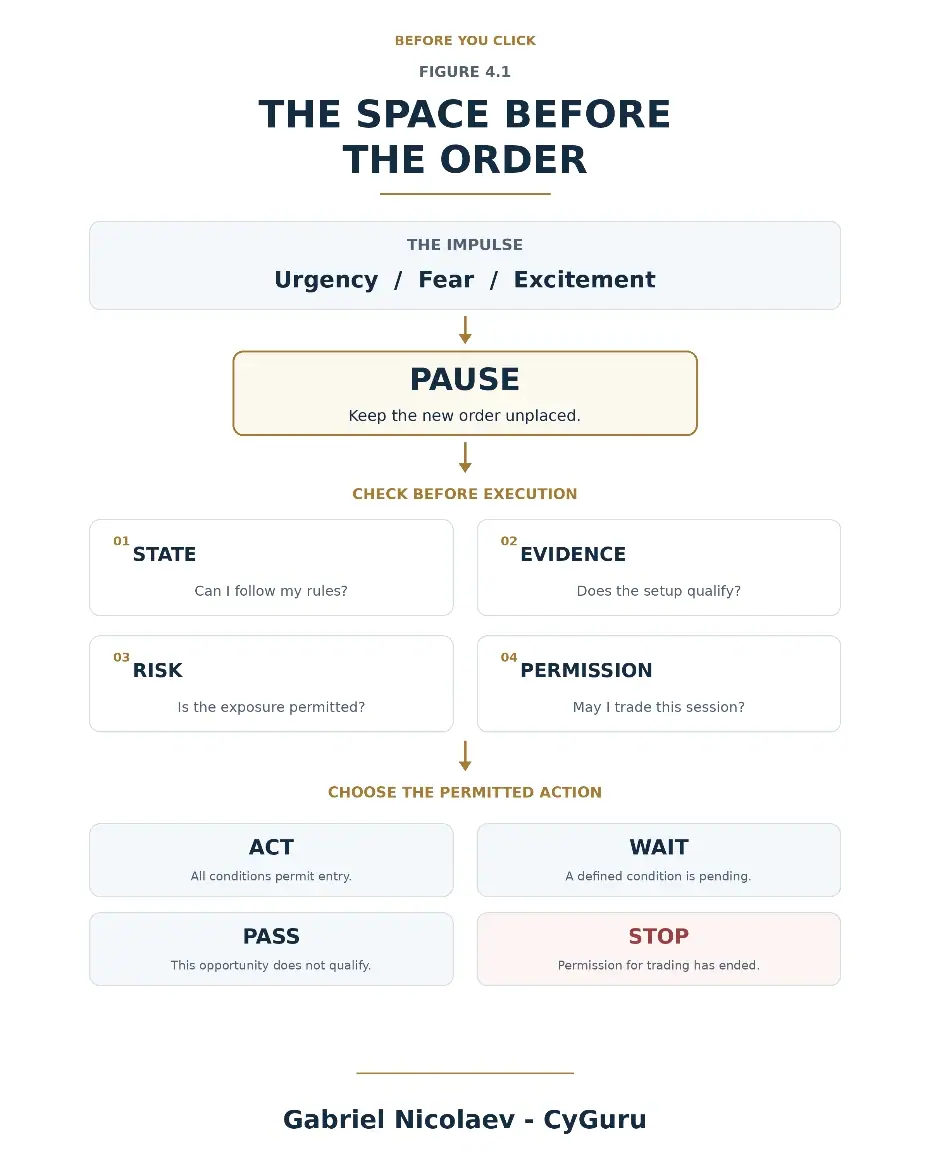
What decision remains defensible when urgency is high?
Separate a market observation from an internal state. Write the exact new information that would authorize BUY, SELL, WAIT or EXIT. A desire to stop waiting is not a trigger; a favorable later price move does not retroactively create one.
Precommit to operating permissions for news windows, fatigue, consecutive rule breaches and correlated open exposure. A pause rule must specify an observable event and a restart condition, rather than a vague instruction to “be disciplined.”
Record the decision before the order ticket: setup identity, frozen levels, invalidation, size, data quality and state check. Afterward, grade process fidelity separately from price outcome. The best review includes a profitable deviation and a correct no-trade decision.
Worked reasoning · hypothetical
Hypothetical exercise: a valid setup appears five minutes before a release, but the written protocol suspends new orders inside a ten-minute window. The decision is WAIT. If price reaches the target later, it remains a correct WAIT under the frozen protocol; the outcome does not rewrite eligibility.
Evidence gates
- Is the pause triggered by observable conditions?
- Can a no-trade decision be logged and reviewed?
- Would an attractive outcome change the process grade?
Draft an order authorization card and a no-trade log, then apply both to two conflicting scenarios.
Decision framework
- Write the entry condition and invalidation before opening an order ticket. A desire to participate does not satisfy a rule.
- Treat WAIT as an explicit outcome in the decision log, including the reason and the condition that would permit a later reassessment.
- Define what an event release, a recent loss or fatigue changes in your operating permissions before those pressures occur.
Where the method fails
A trader may rename urgency as conviction. The audit question is whether a new market observation occurred or only the discomfort of waiting increased.
Review question
Did the decision follow a rule available before the action, even if the eventual price movement was favorable?
Apply it
Write a six-line pre-order protocol: evidence, invalidation, size, event risk, current state and a reason to wait. Apply it to two hypothetical setups, including one rejection.
Exercises are educational. Hypothetical prices and paper decisions are not historical results, broker executions or personal investment advice.
What is the decision when the event clock changes?
This is an invented exercise, not a historical chart, production signal or broker trade. Commit your reasoning before seeing the next information.
Known at the decision point
- A hypothetical setup meets a visual pattern, but an economic release is due within the no-order window in your written protocol.
- You feel urgency because the price is moving. No new observation has changed the written event rule.
Your task: Choose BUY, SELL, WAIT or REJECT and define the earliest valid reassessment condition.
Applied knowledge check
Answer all three questions correctly to record completion on this device. You can revise an answer after reading its explanation.
1. What does feeling calm prove about the direction of XAU/USD?
2. Your rule suspends entries before a scheduled release, but a setup appears. What is the authorized action?
3. A prohibited trade later reaches its target. What is its process grade?
Gabriel Nicolaev — CyGuru