

Price action and invalidation
Multi-timeframe map
The lesson
A setup needs a defined observation point, direction, level history and invalidation rule. A line moved after the outcome changes the hypothesis. Mark the higher timeframe context, the trigger timeframe and the level that would disprove the premise. A wick through a level and a confirmed close are different rules.
Can the same price-action rule be applied before and after the outcome?
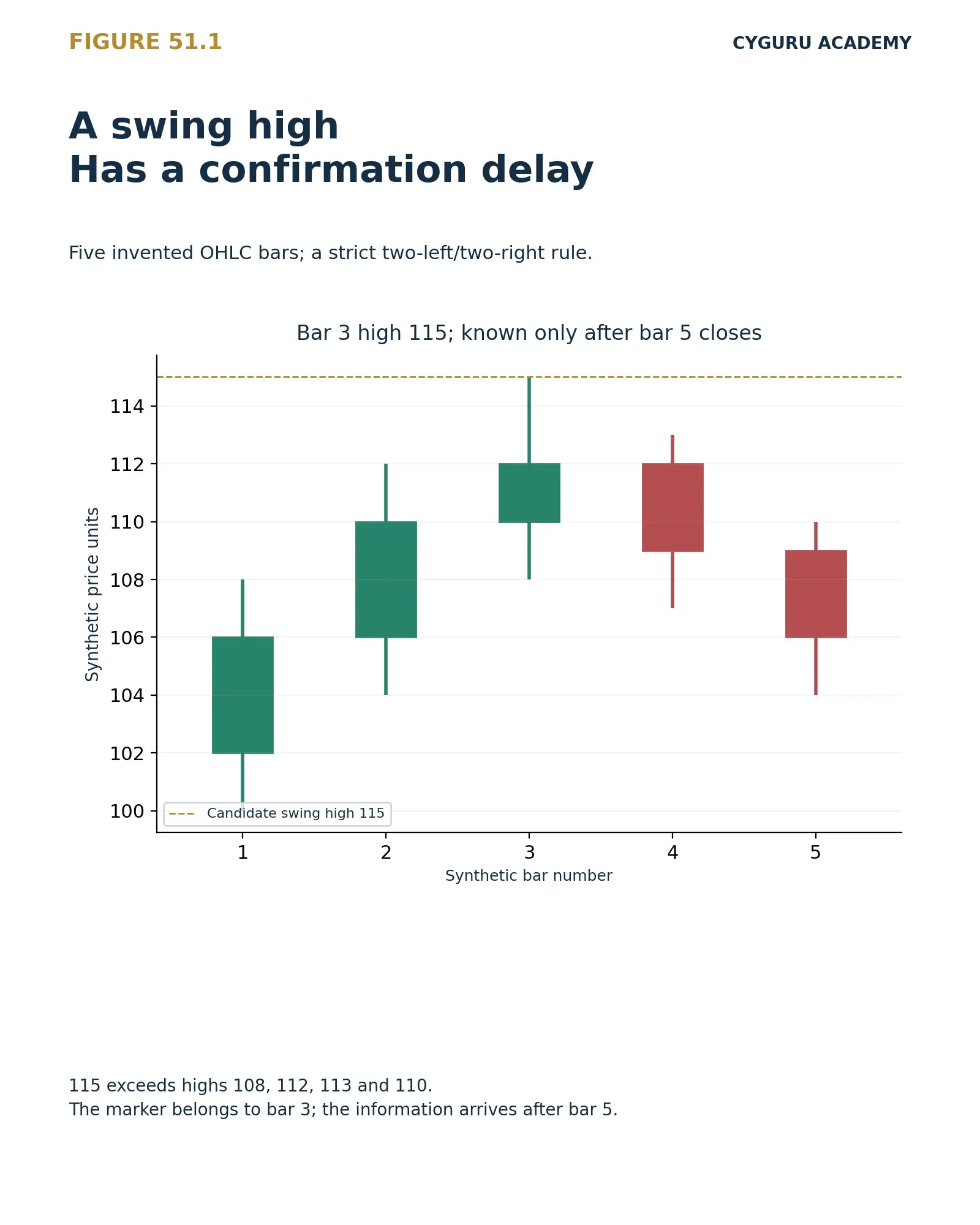
Define the higher-timeframe regime and the trigger timeframe in terms of completed bars. A swing point, break of structure or retest must have a measurable rule: number of bars, close versus wick, buffer and the precise time at which confirmation exists.
Freeze support, resistance, entry zone and invalidation before revealing later bars. Store a screenshot only as a view of those frozen values; the source bars and written rule remain primary. A zone redrawn after the result is a new hypothesis, not evidence for the old one.
Replay forward one recorded close at a time. Include candidates rejected because a confirmation was incomplete, the spread made the setup unusable, or a competing higher-timeframe condition failed. This prevents an archive of only attractive outcomes.
Worked reasoning · hypothetical
Hypothetical example: a rule requires a 15-minute close above a frozen level. A wick crosses it at 10:10, but the 10:15 bar closes below. Under the stated rule there is no confirmed breakout, regardless of whether price later rallies. A later 10:30 close above is a separate decision point.
Evidence gates
- Were levels and bar-close rules written before the outcome?
- Does the replay include rejected setups?
- Can a second analyst reproduce the trigger without hindsight?
Save three replay packets: frozen map, chronological bar decisions and final audit, including at least one rejection.
Decision framework
- Set the higher timeframe context and the lower timeframe trigger before displaying later bars. Both timeframes need explicit bar-close rules.
- Draw a zone only from information visible at the decision time. Its width, boundaries and invalidation rule belong in the original record.
- Log a rejected setup when it met a visual pattern but failed an eligibility condition. Rejected examples reveal whether a filter is applied consistently.
Where the method fails
Moving support to the wick that later survived creates a level that did not exist at decision time.
Review question
Could a second analyst, using only the frozen rules, mark the same trigger and rejection?
Apply it
Annotate three historical windows without revealing later bars. Save the original levels, the decision timestamp and at least one rejected candidate.
Exercises are educational. Hypothetical prices and paper decisions are not historical results, broker executions or personal investment advice.
Is the trigger valid before the next bar?
This is an invented exercise, not a historical chart, production signal or broker trade. Commit your reasoning before seeing the next information.
Known at the decision point
- Your written hypothetical rule requires a confirmed close above a frozen zone. The current bar has pierced the zone but remains open.
- The stop and the higher-timeframe eligibility condition were recorded before this bar began.
Your task: State BUY, WAIT or REJECT and write the exact bar and invalidation rules that justify it.
Applied knowledge check
Answer all three questions correctly to record completion on this device. You can revise an answer after reading its explanation.
1. When should the invalidation level be fixed for a prospective evaluation?
2. A rule requires a completed 15-minute close above resistance. A wick crosses but the bar closes below. What happened?
3. When does a redrawn support zone count as a new hypothesis?
Gabriel Nicolaev — CyGuru