

Gold futures settled at $3,885.30 as the 10-year yield reached 5.10%
The 12 November New York session saw December gold fall 2.88% as nominal and real Treasury yields rose. Friday’s producer-price release tests that backdrop.
New York session reviewed: 2026-11-12
Published
Editorial cutoff · Gabriel Nicolaev — CyGuru

The five-question brief
What happened?
On 12 November, Reuters reported December gold futures settling at $3,885.30 per troy ounce. The U.S. Treasury published a 5.10% ten-year nominal par yield and a 2.86% ten-year real par yield for the same session date.
What explains it?
The 10 November CPI release showed monthly headline inflation of 0.4% and core inflation of 0.3%, both seasonally adjusted. That report was already public before Thursday. Reuters also reported firmer oil prices as hopes for an agreement with Iran faded. Higher real yields and a firmer dollar are consistent with pressure on dollar-priced bullion. The overlap of energy headlines, currency moves and the reopening of cash Treasuries leaves their individual contributions unmeasured. There is no verified order-flow record to attribute the decline to a particular group of sellers.
What is still missing?
The final spot close, a matching intraday OHLC export and the exchange settlement file were unavailable at cutoff. Reuters gives conflicting time labels for its afternoon spot quote. The chart uses reported daily futures settlements. Signal outcomes, broker fills, costs and P&L remain unverified.
What could change the reading?
Contradictory observations over matching timestamps, revised source data or failed follow-through can weaken an interpretation. An explanation must be reconsidered when its required evidence is absent.
What will I watch?
The Bureau of Labor Statistics schedules October PPI for 13 November at 13:30 UTC / 17:30 Dubai. Compare the gold, dollar and Treasury reactions over matching time windows.
On 12 November, Reuters reported December gold futures settling at $3,885.30 per troy ounce. The U.S. Treasury published a 5.10% ten-year nominal par yield and a 2.86% ten-year real par yield for the same session date.
A $115.20 move in the same futures contract
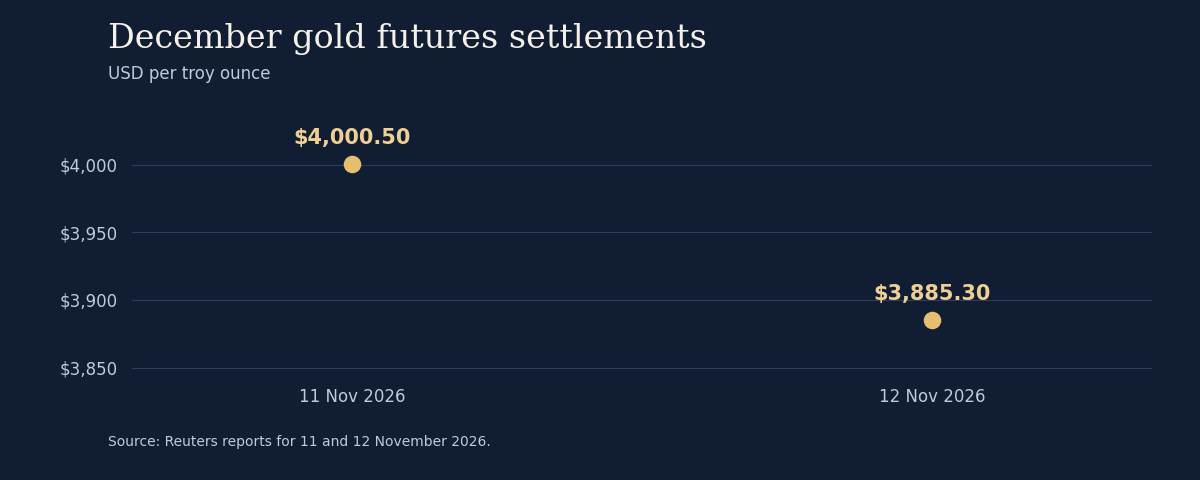
Reuters reported $3,885.30 per troy ounce at the 12 November settlement for December gold futures, down from $4,000.50 on 11 November. Comparing the same delivery month gives a decline of $115.20 per ounce, or 2.88%. The separation matters because switching contracts can introduce a price difference unrelated to the session’s move. The two plotted marks measure the settlement change. They reveal neither the intraday route nor the final spot price.
Spot and the dollar have their own clocks
Reuters put afternoon spot gold at $3,880.93, down 2.7%. Its article pairs 13:53 New York time with 18:55 UTC. In November, 13:53 New York converts to 18:53 UTC, so the reported time carries a two-minute discrepancy. Gold Today retains the New York timestamp converted to UTC and flags the difference. In a separate 12 November dispatch, Reuters reported DXY at 103.17, up 0.29%. The dispatch gives no exact observation time for that reading. FRED’s broader, trade-weighted index still showed 121.8803 for 6 November and therefore supplies a separately dated reference.
Cash Treasuries reopened with higher nominal and real yields
The Treasury’s two-year nominal par yield rose from 4.73% on 10 November to 4.86% on 12 November, a 13-basis-point rise. Over those same dates the ten-year nominal rate moved from 4.98% to 5.10% and the ten-year real rate from 2.78% to 2.86%. The comparison skips the 11 November Veterans Day gap in the official daily curves. The real curve helps distinguish a rise in inflation-adjusted yields from an increase in nominal yields alone. These are dated par-curve observations and the individual readings are not synchronized with the futures settlement.
My reading of the 12 November session
The 10 November CPI release showed monthly headline inflation of 0.4% and core inflation of 0.3%, both seasonally adjusted. That report was already public before Thursday. Reuters also reported firmer oil prices as hopes for an agreement with Iran faded. Higher real yields and a firmer dollar are consistent with pressure on dollar-priced bullion. The overlap of energy headlines, currency moves and the reopening of cash Treasuries leaves their individual contributions unmeasured. There is no verified order-flow record to attribute the decline to a particular group of sellers.
What to measure after Friday’s PPI
October PPI is scheduled for 08:30 New York on 13 November, which is 13:30 UTC and 17:30 Dubai. Compare the release with a forecast recorded before publication. Look at final-demand goods and services separately, then compare the same dollar and gold instruments before and after the release. If gold extends its decline while yields and the dollar ease, that would weaken a rates-and-dollar explanation for the follow-through. If all three move together, record how long that alignment lasts before drawing a conclusion.
Sources and observation times
- Reuters · 12 November gold report · December settlement and afternoon spot quote ↗
- Reuters · 11 November gold report · previous December settlement ↗
- Reuters · 12 November New York currency report · DXY, observation minute unspecified ↗
- U.S. Treasury · 10 and 12 November nominal par curves ↗
- U.S. Treasury · 10 and 12 November real par curves ↗
- Federal Reserve via FRED · broad dollar index, 6 November observation, updated 9 November 21:16 UTC ↗
- BLS · October CPI, released 10 November at 13:30 UTC ↗
- BLS · November calendar, including 13 November PPI at 13:30 UTC ↗
Sources checked for this edition at the editorial cutoff above. Provider observation times remain separate from publication time. Linked statistical pages may later display revised data.
Continue the study
Read inflation releases with precision →
Research Lab: study the price record →
Educational editorial analysis, not a trade recommendation. This archived edition does not update with later announcements.