

Why Gold Can Fall During a Crisis: Liquidity, Margin Calls and Forced Selling
Understand why gold may fall during market stress. Separate liquidity needs, leverage and currency effects from unsupported safe-haven narratives.
Gabriel Nicolaev – CyGuru · 29 October 2026 · 3 min read
In this guide
A long-term role is not a short-term price promise
Calling gold a safe haven describes a possible portfolio role under certain conditions. It does not imply that every frightening headline must immediately raise its price. During stress, market participants face obligations, financing constraints and different time horizons. A useful explanation distinguishes the reason an investor wants to own an asset from the reason another participant must sell it today.
Cash needs can dominate preference
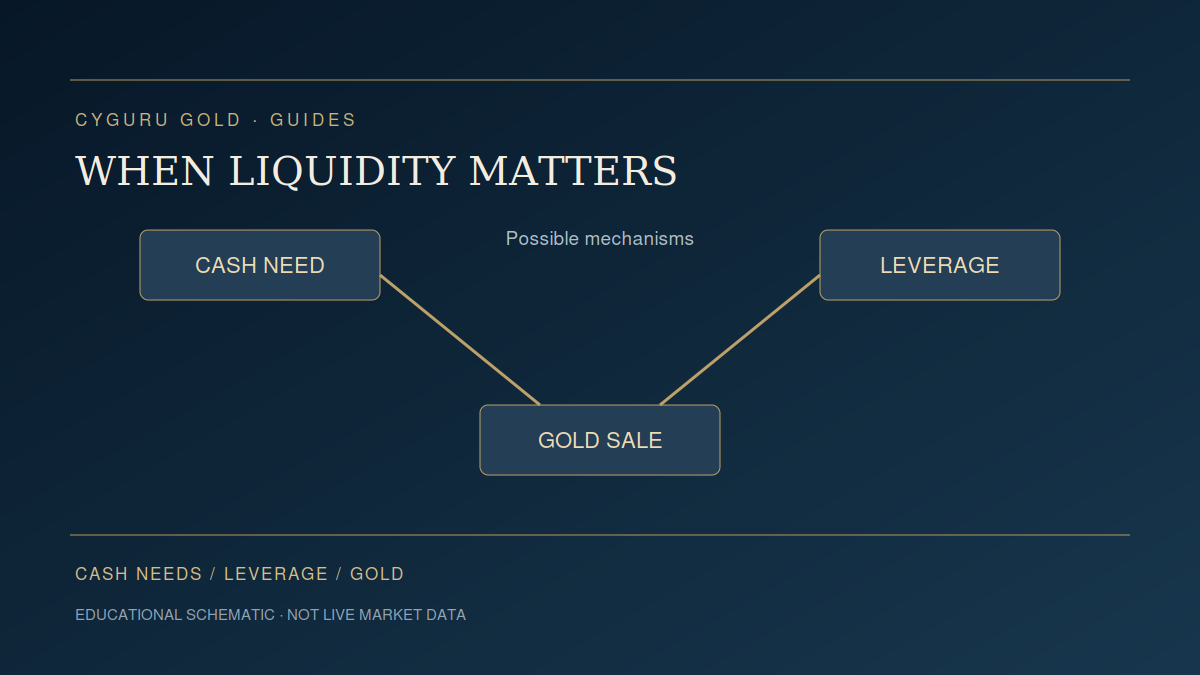
An investor may still value gold while selling it to meet a cash requirement elsewhere. Liquid assets can be easier to sell than impaired or restricted holdings. This is a possible mechanism, not proof of the motive behind any particular candle. The World Gold Council’s March 2020 analysis discussed broad liquidation and the possible use of gold to raise cash during the market disruption.
Leverage can amplify an adjustment
When collateral requirements rise or losses reduce available equity, leveraged participants may need to reduce positions. Their selling need not express a new long-term view on gold. Conversely, not every decline is a margin-call episode. Establish the relevant exchange or broker requirements, timing and position evidence before making that attribution. A price chart alone cannot identify who sold or why.
Distinguish dollar effects from metal effects
XAU/USD expresses gold in dollars. A dollar move can interact with the metal’s valuation and international demand, but the relationship is not fixed. Compare synchronized returns in XAU/USD and XAU/EUR if investigating a currency explanation. Avoid treating a dollar index move, a currency-pair move and a real-yield change as the same explanatory variable.
Paper and physical conditions can differ
A futures quotation, spot benchmark and retail coin premium describe different transactions. During disruptions, physical availability or delivery costs can change while a financial price falls. A high retail premium therefore does not, by itself, invalidate a decline in a spot series. Specify product, location, timestamp and units before comparing apparently contradictory gold prices.
Build an evidence table before naming a cause
Record the observed gold return, dollar change, selected yield change, financing conditions and relevant official announcements over one defined interval. Mark each proposed mechanism as supported, plausible or unverified. Multiple mechanisms can coexist. If the timing does not fit the explanation, preserve that contradiction. The discipline is to make uncertainty visible rather than replace it with a dramatic story.
What this means for the trading process
Do not average into a falling leveraged position solely because gold is supposed to protect against crisis. Separate a portfolio allocation thesis from an intraday setup and from the cash needed to sustain either. Define invalidation, position limits and observation-only conditions in advance. Continue with the rates guide and execution guide to connect the narrative with measurable variables and practical exposure.
Follow a connected reading path
Sources and definitions
Source links support the definitions and background identified in this guide. Study protocols and invented examples are original educational analysis, not validated trading results.
Gold Trading Mastery
Explore the wider framework and available formats in the author’s store.
View on CYGURU.COM →Connect your reading
- Gold, rates and the dollar: identify the variable first
- Trading Gold Around Economic Releases: Spreads, Slippage and Execution Risk
- The Gold Trading Journal: Measure Decisions, Not Just Profit
Explore Research Lab → · Trading Toolkit → · Prepare your session →
Education, not personalized advice or a validated prediction model. Hypothetical calculations exclude costs unless specified.