

Gold Breakout or Fakeout? A Framework for Evaluating the Move
Evaluate gold breakouts using predefined boundaries, completed candles, retests and invalidation. Avoid hindsight when studying XAU/USD false breaks.
Gabriel Nicolaev – CyGuru · 29 October 2026 · 3 min read
In this guide
A breakout needs a boundary and a clock
Without a boundary fixed before the move, almost any chart can be described as a breakout. Specify whether the reference is a range edge, previous-day extreme or another reproducible zone. Then specify which timeframe determines a qualifying close. A five-minute close and a one-hour close describe different information sets. Neither becomes superior simply because it looks cleaner after the move.
Confirmation changes the entry economics
Waiting for a completed close can filter some temporary crossings, but it also changes entry price and stop distance. A strategy must evaluate both effects together. Do not compare the success rate of confirmed entries with the early entry prices of unconfirmed ones. Confirmation is an extra condition, not a guarantee of continuation or an excuse to ignore the cost of being later.
Treat the retest as an optional rule
A retest can mean a touch, a close within a zone or a return within a defined distance. Choose one definition and a time limit. Some moves continue without returning, while others retest repeatedly before failing. If a rule requires a retest, missed moves belong in the opportunity record. Adding a retest requirement only to losing historical cases produces a misleading result.
Work through two possible paths
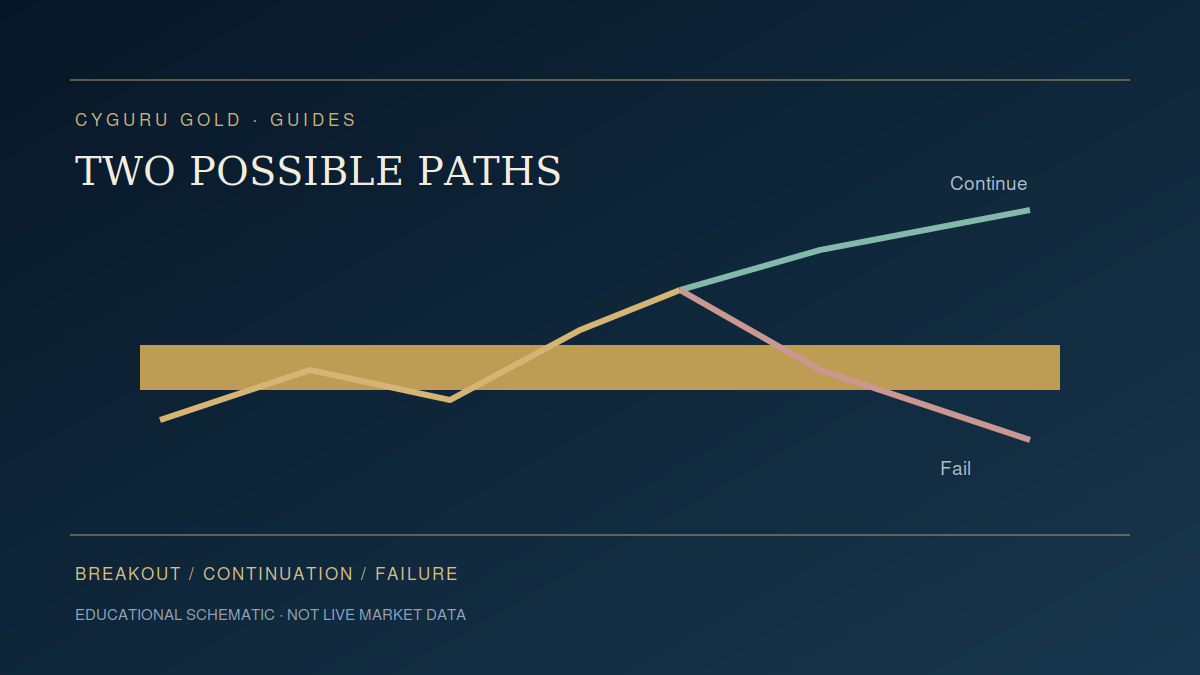
Imagine a zone ending at 2,010. A bar closes at 2,013. In one path, later closes remain outside and the price expands upward; in another, price closes back at 2,007. These are hypothetical branches, not a forecast. A test might define failure as a close below the zone within four bars. That definition must exist before either path is evaluated.
Scale the observation to market conditions
Record distance beyond the zone relative to recent volatility, spread and zone width. A two-dollar excursion means something different when the typical bar range is one dollar than when it is twelve. ATR supplies a backward-looking scale, not a continuation probability. Scheduled news can change the execution environment faster than an average volatility measure adapts.
Define what invalidates the hypothesis
Invalidation concerns the market condition that would contradict the setup. The protective order concerns how the position is managed if that condition develops. They are related but not identical. A stop price may differ from a candle-close invalidation rule. If the method waits for a close, explicitly model the possible loss before that close and the eventual exit execution.
Keep the test honest
Save every eligible boundary and apply identical confirmation, entry and exit rules. Use later data to evaluate the frozen rule, including failures, missed entries and transaction costs. Compare breakout trades with a baseline across multiple conditions. A high win rate without average win, average loss and drawdown tells little about whether the approach is usable.
Follow a connected reading path
Sources and definitions
Source links support the definitions and background identified in this guide. Study protocols and invented examples are original educational analysis, not validated trading results.
The Gold Trader’s Code
Explore the wider framework and available formats in the author’s store.
View on CYGURU.COM →Connect your reading
- Support and Resistance in Gold: Building Zones That Matter
- Gold Liquidity Sweeps: Reading False Breakouts Around Key Levels
- How to Backtest a Gold Trading Strategy Without Fooling Yourself
Explore Research Lab → · Trading Toolkit → · Prepare your session →
Education, not personalized advice or a validated prediction model. Hypothetical calculations exclude costs unless specified.