

The Gold Trading Journal: Measure Decisions, Not Just Profit
Create a gold trading journal that separates decisions from outcomes, records execution costs and measures expectancy, rule adherence and drawdown.
Gabriel Nicolaev – CyGuru · 29 October 2026 · 3 min read
In this guide
A profitable trade can hide a poor decision
A result tells you what happened on one path. It does not establish whether the decision was justified with the information available beforehand. A rule-breaking trade can win, and a well-defined trade can lose. A useful journal preserves both dimensions. Otherwise, the trader rewards lucky behavior and abandons sound processes whenever a short sequence feels uncomfortable.
Record the plan before the outcome
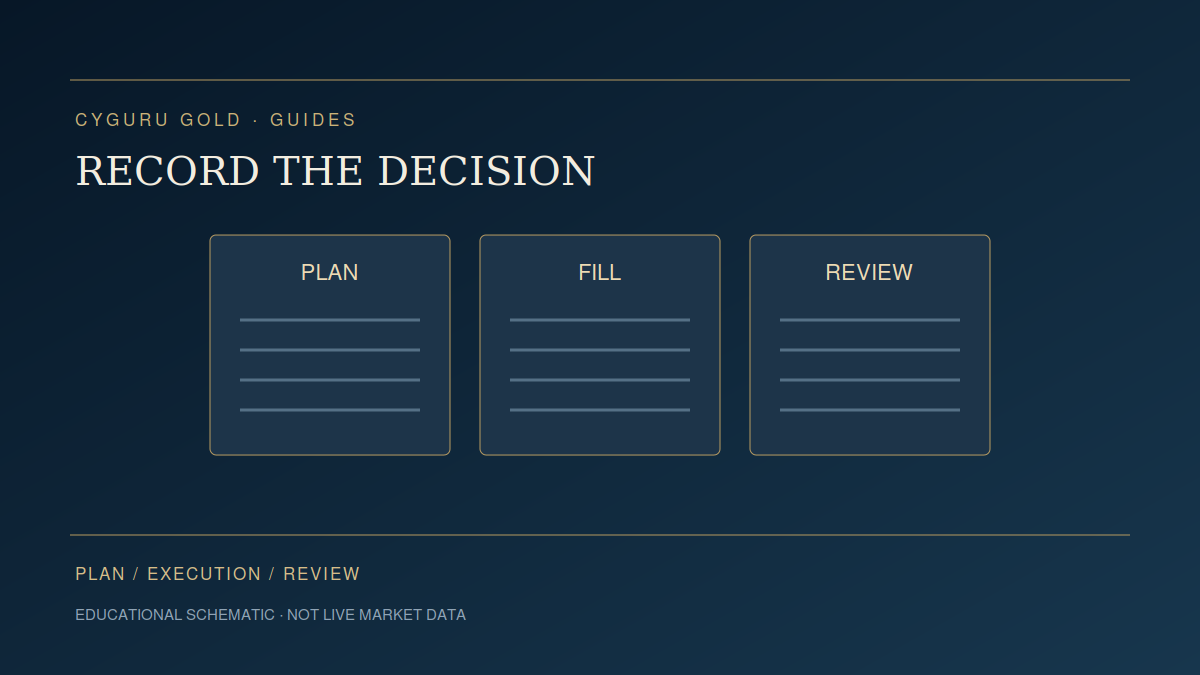
Save instrument, provider, timeframe, session, event context, setup version, entry condition and invalidation. Include planned size, estimated costs and monetary exposure. Timestamp the record and keep the original screenshot. Later amendments should be additions rather than replacements. A plan written after closing the trade cannot reliably distinguish anticipation from hindsight, even if the reconstructed narrative feels sincere.
Keep the execution ledger separate
Record actual entry and exit prices, quantity, fees, financing, order type and relevant partial fills. Note differences between requested and executed prices. Distinguish a missed order from a canceled setup and from a deliberate no-trade decision. Those outcomes answer different questions. A screenshot of a candle does not substitute for an execution record when studying realized performance.
Use a consistent definition of R
Define initial R as the predeclared monetary risk measure for the trade and state whether its denominator includes estimated costs. Then divide actual net profit or loss by that fixed initial value. A hypothetical net profit of 180 dollars against initial risk of 120 dollars is +1.5R. A loss of 150 dollars is −1.25R. Do not shrink the denominator after a favorable stop adjustment.
Measure behavior without inventing a diagnosis
Use concrete fields: entered before confirmation, increased size outside the rule, moved the stop, or reopened without a new setup. Add a short self-report of urgency or fatigue if useful, but do not treat it as a clinical measure. Review behavior across multiple observations. One loss during stress does not establish that stress caused it, and one calm win does not validate the method.
Review distributions and clusters
Separate results by setup version and examine sample counts before comparing sessions or conditions. Track average net R, loss size, drawdown and rule adherence. Do not select the best subgroup after dozens of comparisons and present it as a discovery without a later test. Preserve excluded trades and explain exclusions. A clean report is valuable only if it still represents what actually happened.
End the review with one testable change
Choose a specific process adjustment, record the reason, and assign a period for review. For example, require a timestamped plan before an order rather than vaguely promising more discipline. Keep strategy changes separate from behavior changes so their effects can be examined. Use Before You Click for the broader decision-making framework and the backtesting guide to evaluate rule revisions without rewriting previous results.
Follow a connected reading path
Sources and definitions
Source links support the definitions and background identified in this guide. Study protocols and invented examples are original educational analysis, not validated trading results.
Before You Click
Explore the wider framework and available formats in the author’s store.
View on CYGURU.COM →Apply this framework to dated research
Connect your reading
- How to Backtest a Gold Trading Strategy Without Fooling Yourself
- Gold Volatility and ATR: Sizing Stops for Changing Conditions
- From headline to execution: where a convincing story can fail
Explore Research Lab → · Trading Toolkit → · Prepare your session →
Education, not personalized advice or a validated prediction model. Hypothetical calculations exclude costs unless specified.