

Trading Gold Around Economic Releases: Spreads, Slippage and Execution Risk
Study gold execution around CPI, NFP and FOMC: bid–ask spreads, order triggers, slippage and why chart prices are not guaranteed fills.
Gabriel Nicolaev – CyGuru · 29 October 2026 · 3 min read
In this guide
The release and the fill run on different clocks
A report can be published, delivered to your news source, processed by your platform and acted on by your order at different times. The timestamp on a candle does not identify all those stages. Preserve the official event time, your receipt time and the order record when available. An apparent reaction visible on a historical chart may not have been executable at the quoted price.
Name the quotation side
A bid, ask, midpoint and last-traded series are different observations. Many retail gold charts do not show the complete bid–ask history. A buy normally pays the ask and an exit sale receives the bid under ordinary two-sided dealing conventions, but exact execution terms depend on the product. Check which side triggers each stop. A bid candle alone may not reveal that an ask-triggered order was reached.
Spread is a variable cost
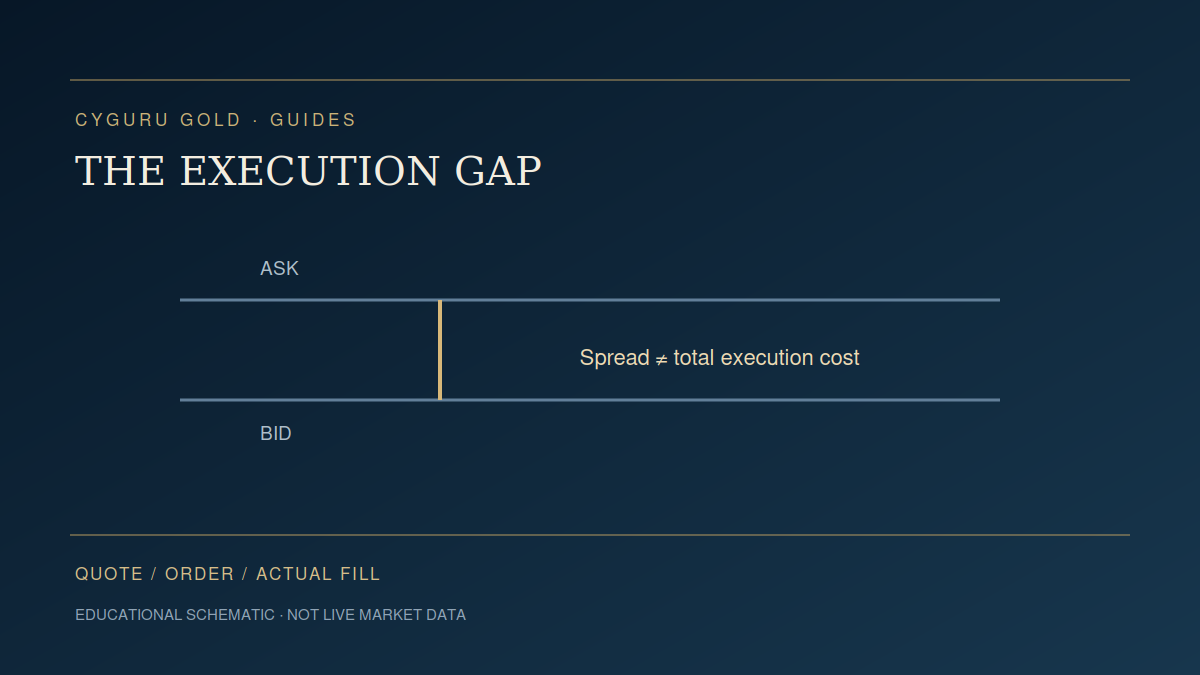
In an invented example, a bid of 2,000 and ask of 2,000.50 imply a 0.50-dollar spread per ounce. If the ask later becomes 2,002 while the bid stays 2,000, the spread is 2 dollars. An immediate round trip at those quotes loses the spread before other charges. Do not count that cost twice if the backtest already uses separate executable bid and ask prices.
Market, limit and stop instructions solve different problems
A market order prioritizes execution over a specified price. A limit constrains price but may not fill. Stop behavior varies: some trigger market-style orders while others apply limit conditions. Verify the exact provider terminology and protections. A touched historical level is not proof of a fill, particularly when available size and quote duration are unknown.
A planned loss can be exceeded
For a hypothetical five-ounce long entered at 2,000 with a planned exit at 1,990, price-distance risk is 50 dollars. If the actual exit is 1,987, price loss is 65 dollars before separately charged costs. This arithmetic does not estimate how often slippage occurs. It shows why a risk budget based on a stop price is an estimate rather than an unconditional cap.
Build an event-specific observation protocol
Use the official CPI, employment or FOMC schedule and account for local time changes. Record conditions before the release, at receipt and after the chosen observation horizon. Preserve revised announcements and platform problems. Define beforehand whether the process permits participation, delayed observation or no trade. A checklist cannot make an untested event strategy reliable.
Evaluate execution separately from the market idea
A directional thesis can be correct while the entry is uneconomic after costs. Log requested price, fill, spread, latency information and exit reason separately from the macro narrative. Compare normal and stressed cost assumptions in research. If the available history lacks bid–ask data, label the limitation rather than manufacture precise net returns. Continue with ATR sizing and the backtesting guide.
Follow a connected reading path
Sources and definitions
Source links support the definitions and background identified in this guide. Study protocols and invented examples are original educational analysis, not validated trading results.
The Gold Trader’s Code
Explore the wider framework and available formats in the author’s store.
View on CYGURU.COM →Apply this framework to dated research
Connect your reading
- Inflation and jobs: the headline is not the whole release
- Gold Volatility and ATR: Sizing Stops for Changing Conditions
- How to Backtest a Gold Trading Strategy Without Fooling Yourself
Explore Research Lab → · Trading Toolkit → · Prepare your session →
Education, not personalized advice or a validated prediction model. Hypothetical calculations exclude costs unless specified.