

Why a jeweller’s rising sales can accompany fewer grams of gold
A sales receipt measures money changing hands. A bullion analyst wants to know how much fine gold went into the piece. A workshop taking old jewellery in exchange has a third question: how much fresh metal does it need to buy?
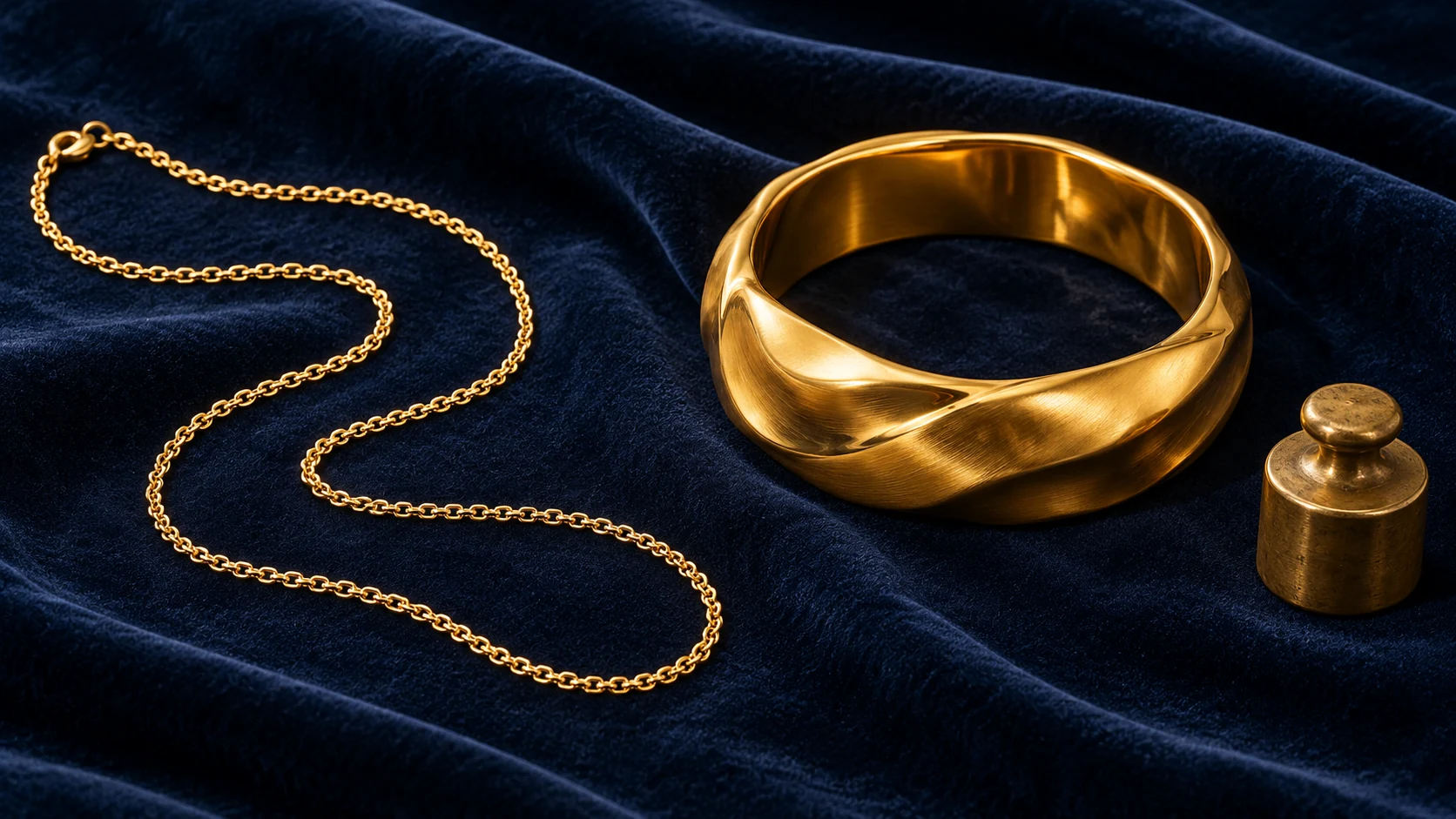
- Fine grams, pieces sold and transaction value measure different things.
- The first-half Chinese estimate values metal at a Shanghai benchmark. It is separate from retailers’ turnover.
- A physical-demand inference from retail sales needs comparable store coverage, purity, weight and an understanding of exchanges.
Start with an observed gap
In its 16 October report on China, the World Gold Council estimated that the value of jewellery consumption reached RMB144 billion in the first half of 2026, up 5% year on year, while its gold weight fell 30%. The valuation uses quarterly average Shanghai Au9999 prices. It is a metal-value estimate, so it will differ from the sum of customer receipts that include workmanship and other retail charges.
The global quarterly series provides a separate reference. The Council’s July release put second-quarter jewellery consumption at 278.2 tonnes worldwide against 335.3 tonnes a year earlier. Neither observation is an October sales total. The newer Chinese research and the global table describe different geographies and periods, which matters when an apparently strong local sales headline arrives.
Source notes: [1] World Gold Council — 2026 Chinese jewellery retailer insights · [2] World Gold Council — Q2 2026 Gold Demand Trends, jewellery
Two bangles, one customer budget
Consider a hypothetical shopper comparing a 10-gram 22-carat bangle with an 8-gram 18-carat one. For this example, the stated weights exclude stones. Fine gold weight equals the metal weight multiplied by carats divided by 24. The first piece contains about 9.17 grams of gold. The second contains 6 grams. Selling one piece in either case records one unit at the till, while the second sale embodies about a third less gold.
Those weights alone cannot determine which bangle costs more at retail. Design, workmanship, the gold price at sale and retailer charges may differ. If the customer supplies an old piece toward payment, the ticket value, cash collected and additional metal required can all differ again. I would ask for the treatment of exchanges before using sales revenue to estimate what the retailer ordered from a refiner.
What the October update from India adds
On 20 October, the Council reported year-on-year revenue growth of roughly 20% to 30% among listed Indian jewellery retailers for July through September. It also described double-digit increases in average ticket size and mid-single-digit buyer growth. That is evidence about a group of retailers. It does not tell us the fine weight of the average basket or establish a national quarterly tonnage estimate.
In my reading, ticket and buyer counts can help explain how sales grew without settling the physical-demand question. More customers buying lighter pieces and the same customers buying higher-priced pieces are different mechanisms. A retailer adding stores introduces another. Comparing like-for-like store sales with sales across the whole chain helps separate expansion from activity at existing counters. A carat and weight breakdown would still be needed to translate that activity into grams.
Source notes: [3] World Gold Council — India gold market update, Kavita Chacko
Read the next results announcement in three columns
My first column is physical content: fine grams sold and any metal received back. The second is valuation: currency, benchmark and period used to price those grams. The third is commercial: receipts, buyer count and whether the store base changed. I mark unavailable fields as unknown rather than filling in a weight from revenue growth. For a supplier estimating replacement orders, the most useful follow-up may be the jeweller’s inventory and old-gold intake. For a retailer testing customer budgets, average spend per visit may be the better series. Both can be right about the same shop.
Sources, dates & evidence limits
Sources checked 1 November 2026 at 04:09:10 UTC / 1 November 2026 at 08:09:10 Dubai. Source observation and release dates are separate from this article’s publication date. Linked data may later be revised.
- World Gold Council — 2026 Chinese jewellery retailer insights ↗16 October 2026, publication hour not supplied
Chart 6 and its notes give first-half China value, fine-weight change and the quarterly Au9999 valuation basis.
- World Gold Council — Q2 2026 Gold Demand Trends, jewellery ↗30 July 2026, publication hour not supplied
World jewellery consumption table compares Q2 2025 and Q2 2026, in tonnes.
- World Gold Council — India gold market update, Kavita Chacko ↗20 October 2026, publication hour not supplied
July–September listed retailer sales, buyer growth and ticket size. Retailer commentary has a narrower scope than national consumption.
Follow the reading path
Gold, rates and the dollar: identify the variable first →Physical Gold & Ownership →Research Lab: test the evidence →CyGuru trading books: continue your study →Follow new Gold Intelligence articles →All 1 November 2026 articles →Gold Intelligence library →Original educational analysis. Illustrative calculations are not historical performance. Interpretation is identified in the text; no trade outcome is established by this article. Editorial standards →