

The assay is precise. Was the gold sample representative?
The credibility of a gold assay starts before the sample enters the instrument.
- A precise result does not prove that a sample represents the whole object.
- Surface screening and fineness determination have different scopes.
- Agree sampling, custody and dispute procedures before relying on a certificate.
The certificate contains a result and an inference
A laboratory can measure the material placed in front of it with considerable precision. The commercial question is usually broader: what does that result establish about the bar or lot being sold? The bridge between those questions is the sampling procedure. If that bridge is weak, adding decimal places to the certificate does not repair it.
This is a physical-market analysis of measurement scope, using LBMA guidance freshly checked on 10 November. It adds a different question to the existing Dubai guides about fine weight and product comparison: how was the fineness evidence obtained? No particular dealer, refinery or bar is being accused of a defect, and no new laboratory test is reported.
A surface observation has a limited reach
LBMA’s physical-market guidance distinguishes non-destructive screening from representative fineness determination. It notes that X-ray fluorescence examines a shallow surface and requires homogeneity for an inference about possible fineness. Ultrasound can help detect inclusions or internal discontinuities but does not supply a fineness measurement. Different tools therefore answer different questions.
My purchasing question would be specific: what property was tested, over what part of the item, and under which assumptions can the result be extended to the whole object? A successful screening test may reduce one concern while leaving another unresolved. Describing every test as an “assay” can conceal that difference and create more confidence than the evidence warrants.
Source notes: [1] LBMA — Physical Market Guidelines
Sampling error can survive excellent analysis
LBMA’s technical discussion of assaying emphasizes that analytical techniques depend on a true, homogeneous, representative sample; an error introduced during sampling cannot be corrected later in analysis. That principle matters when material varies across a consignment. Repeating the measurement of the same unrepresentative fragment can reproduce the same misleading answer.
Consider an explicitly invented lot made of two physically distinct materials. Testing only the cleaner material tells us about that selected portion. Even a perfectly repeatable laboratory result does not determine the lot’s average composition. This is a logic example rather than a recommended sampling technique: actual protocols depend on the form of material, the agreed transaction and the qualified laboratory’s procedure.
Source notes: [2] LBMA Alchemist — All That Glisters is Not Au/Ag/Pt/Pd/Ru/Rh/Ir/Et Al
Ask how the sample and the transaction were connected
I would request a record identifying the item or lot, the sampling method, the person responsible, the sample’s custody and the report that analyzed it. Where a retained split sample exists, ask how it is identified and under what agreed conditions it can be examined. The aim is to connect the commercial object to the analytical result without relying on a verbal assurance.
LBMA’s proactive monitoring offers an institutional example: supervised dip samples from a normal melt are distributed for comparison between a refiner’s analysis and referee results. That process illustrates the value of controlled sampling and comparison. It should not be presented as a promise that every retail item has individually undergone that procedure. The scope of the programme and the scope of a particular purchase are different.
Source notes: [3] LBMA — Proactive Monitoring
The economic question includes the cost of resolving doubt
If further testing is proposed, agree who authorizes it, what happens to the object, who pays, and how a disputed result will be handled before the work begins. LBMA states that representative sampling for fineness determination destroys the bar. For a buyer, that makes the decision different from simply placing a sealed product on a scanner.
The commercial value of retaining an intact object can differ from the value of the metal after testing and processing. I would therefore compare a documented acceptance process with the actual uncertainty being resolved. This article does not suggest that every retail buyer should destroy a bar or conduct a laboratory procedure; it explains why testing terms belong in a serious product comparison.
Source notes: [1] LBMA — Physical Market Guidelines
A more useful confidence statement
Instead of writing “the gold is verified,” state exactly what was verified: a reported weight, a surface measurement, a representative sample, or consistency with a documented chain of custody. The strongest statement supported by the evidence may be narrower than the phrase used in advertising. That narrower statement is more useful because another person can check it.
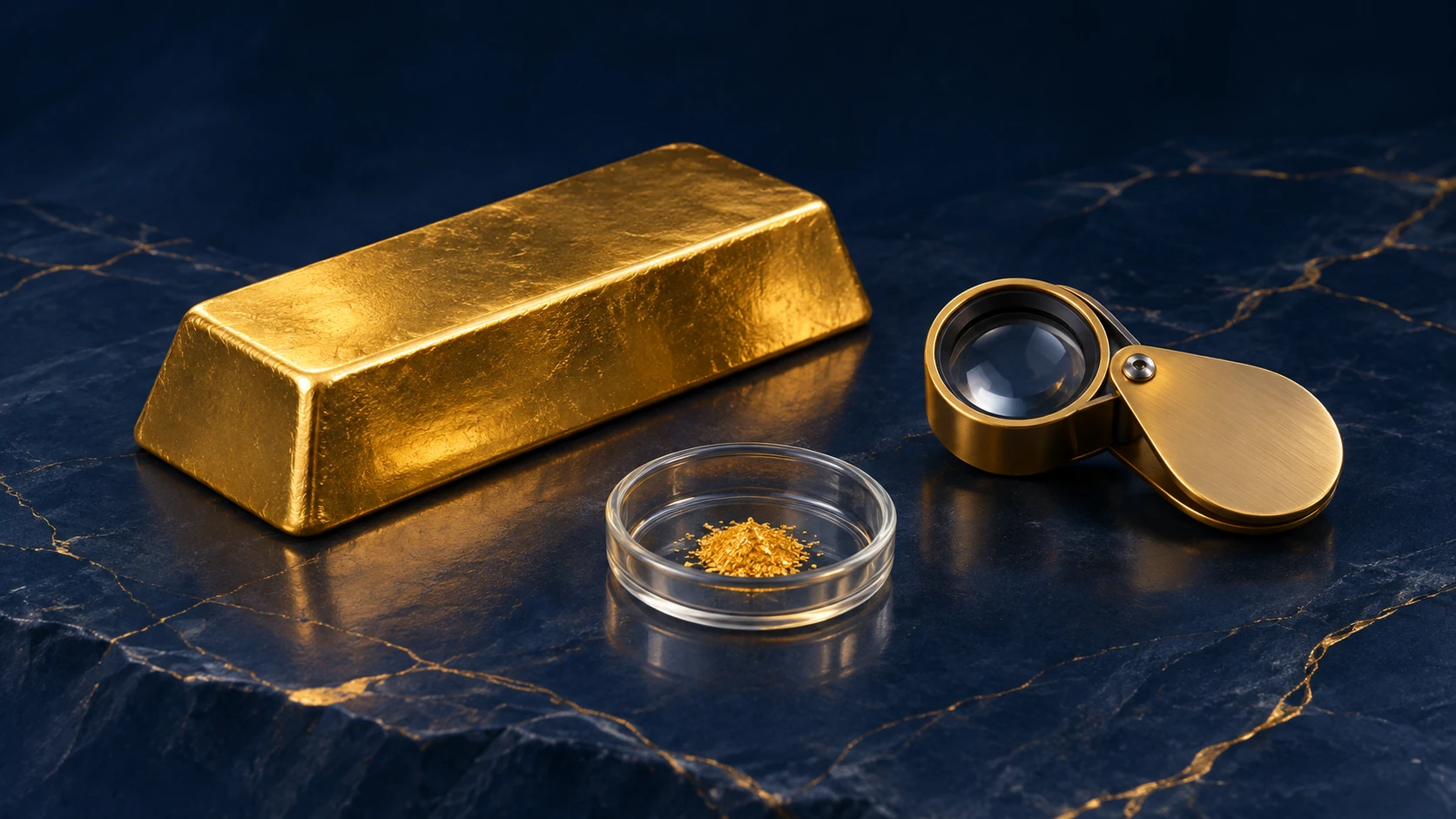
The Dubai product guide helps compare fine content and complete transaction cost; this article supplies the measurement question that precedes using a fineness number. Its illustration is conceptual, not a laboratory record. No assay value, dealer quotation or finding of counterfeit metal is invented. The purpose is to make confidence traceable to a procedure rather than to the number of decimals on a page.
Sources, dates & evidence limits
Sources checked 10 November 2026 at 04:06:29 UTC / 10 November 2026 at 08:06:29 Dubai. Source observation and release dates are separate from this article’s publication date. Linked data may later be revised.
- LBMA — Physical Market Guidelines ↗Undated methodological reference; publication hour unavailable
Freshly checked on 10 November 2026. This article reports methodology rather than a new market observation.
- LBMA Alchemist — All That Glisters is Not Au/Ag/Pt/Pd/Ru/Rh/Ir/Et Al ↗Alchemist Issue 48; original publication hour unavailable
Freshly checked on 10 November 2026. This article reports methodology rather than a new market observation.
- LBMA — Proactive Monitoring ↗Undated methodological reference; publication hour unavailable
Freshly checked on 10 November 2026. This article reports methodology rather than a new market observation.
Follow the reading path
The Gold Trading Journal: Measure Decisions, Not Just Profit →Physical Gold & Ownership →Research Lab: test the evidence →CyGuru trading books: continue your study →The separate Daily Gold Brief: session context →Dubai physical gold: contracts and product comparison →Research Lab: evidence and methods →Follow new CyGuru research →Follow new Gold Intelligence articles →All 10 November 2026 articles →Gold Intelligence library →Original educational analysis. Illustrative calculations are not historical performance. Interpretation is identified in the text; no trade outcome is established by this article. Editorial standards →